
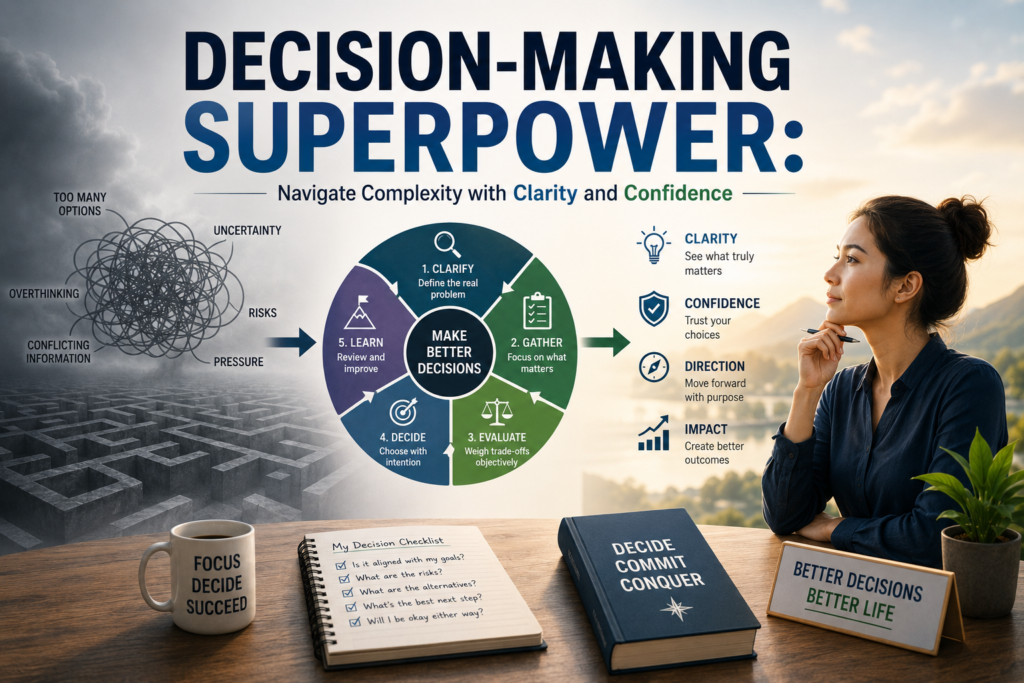
We’ve all been there. Staring at a fork in the road, or perhaps more accurately, a hundred diverging paths, feeling a prickle of anxiety and a heavy sense of paralysis. It’s the job offer you’re not sure about, the investment that feels risky, the creative project you can’t quite start. The sheer volume of information,  the potential consequences, the fear of making the “wrong” choice – it can all conspire to lock us in a state of indecision. This isn’t a sign of weakness; it’s a common human experience, often amplified in our hyper-connected, information-saturated world of 2026. But what if I told you that you possess an innate superpower to navigate this complexity with clarity and confidence? It’s not about having all the answers or eliminating all risk, but about mastering the art of making better decisions.
The Hidden Traps: Why We Often Stumble in Decision-Making
Before we delve into sharpening our decision-making prowess, it’s crucial to understand the invisible forces that often steer us off course. Our brains, brilliant as they are, employ mental shortcuts,
or heuristics, to process the overwhelming amount of information we encounter daily. While these shortcuts are often efficient, they can also lead us astray, a phenomenon known as cognitive bias. Think of them as hidden traps in the decision-making landscape.
One of the most pervasive is confirmation bias. This is our tendency to seek out, interpret, and favor information that confirms our pre-existing beliefs, while dismissing evidence that contradicts them. It’s like wearing blinders that only allow us to see what we already believe to be true. In practice, this can mean a business leader only seeking data that supports a pet project, or an investor ignoring negative news about a stock they’re already invested in.
Then there’s the overconfidence bias, where we overestimate our abilities, knowledge, and the accuracy of our predictions. This can lead to taking on excessive risks or making decisions without adequate preparation, assuming we know more than we actually do. The “planning fallacy,” a type of overconfidence, is the tendency to underestimate how long tasks will take.
The status quo bias, or inertia, makes us prefer things to stay the same and resist change, even when better options exist. Change often involves uncertainty, and our comfort with the known, even if suboptimal, can hold us back from seizing valuable opportunities.
Consider also the availability bias, where we tend to overestimate the importance of information that is easily recalled, often because it’s recent or dramatic. The constant barrage of news, for instance, can make us fear low-probability, high-impact events more than common, but less sensational, risks.
These biases, along with many others like anchoring, loss aversion, and similarity bias, aren’t about intentional wrongdoing. They’re ingrained psychological tendencies that can subtly influence our judgments, leading to less rational and suboptimal outcomes.
Beyond Analysis Paralysis: Cultivating Smarter Decision-Making Habits
The antidote to these hidden traps isn’t about eliminating all risk or striving for an unattainable perfect decision. It’s about developing a more robust and intentional decision-making process. The good news is that this is a skill that can be honed, much like any other.
1. Embrace Structure: The Power of a Decision-Making Framework
In a world that often feels chaotic, a structured approach can be your anchor. The Rational Decision-Making Model provides a systematic way to tackle choices, big or small. It’s akin to applying the scientific method to your life’s decisions.
- Define the Problem/Opportunity: Be crystal clear about what you’re trying to decide. What is the core issue or goal? Vague problems lead to vague solutions.
- Identify Decision Criteria: What factors are most important in making this choice? What standards will you use to evaluate options? For instance, when hiring, criteria might include experience, skills, cultural fit, and salary expectations.
- Weigh the Criteria: Not all criteria are equal. Assign a weight or rank to each factor based on its importance. This helps prevent being swayed by less critical elements later on.
- Generate Alternatives: Brainstorm all possible solutions or courses of action. Don’t censor ideas at this stage; the more options, the better.
- Evaluate Alternatives: Systematically assess each option against your weighted criteria. What are the pros and cons of each? This is where objective analysis comes into play.
- Choose the Best Option: Select the alternative that best meets your criteria and desired outcome.
- Implement and Review: Put your decision into action and then, crucially, review its effectiveness. What worked? What didn’t? What can you learn for next time? This feedback loop is vital for continuous improvement.
This structured approach helps to minimize the influence of biases by forcing a more objective evaluation. When you have a clear process, you’re less likely to be swayed by immediate emotional reactions or readily available but potentially misleading information.
2. Master the Art of the “Strategic Pause”
In our fast-paced world, the instinct is often to react immediately. However, taking a moment to pause can be profoundly effective. This isn’t about delaying unnecessarily; it’s about strategic breathing room.
When faced with pressure, a simple deep breath can work wonders. It calms the amygdala, the brain’s alarm system, and allows your prefrontal cortex – the seat of rational thought – to re-engage. Consider mindfulness practices or a brief meditation to center yourself before making a critical choice.
Sometimes, the most powerful action is to question the immediacy. Does this truly need a decision *right now*? Often, a little time can provide crucial clarity or reveal that the urgency was artificial.
Embrace “whitespace walks” or simply step away from the situation. This physical or mental detachment allows for a broader perspective and can dislodge you from a fixed, potentially biased, line of thinking.
3. The Power of Small Wins: Building Momentum, Not Perfection
We often fall into the trap of believing that significant progress only happens through massive leaps. This is a myth. The reality is that sustained progress is built on a foundation of small wins. Celebrating these incremental achievements is not just about feeling good; it’s a powerful psychological driver.
Each small success, no matter how minor, triggers a release of dopamine in the brain, reinforcing positive behaviors and making it easier to continue. This is the “progress principle” at work. It proves to yourself that progress is possible and that you are capable of moving forward.
To leverage this, break down large goals into micro-goals. Instead of focusing on writing an entire book, commit to writing 300 words a day. Instead of aiming for a complete home renovation, focus on completing one room at a time. Track your progress – a journal, a checklist, or an app can make these small victories visible. And most importantly, celebrate each win. This doesn’t have to be elaborate; a short break, acknowledging it to yourself, or sharing it with a trusted friend can be enough. This consistent positive reinforcement prevents discouragement and fuels sustained effort.
The difference becomes clear when you shift your focus from the daunting final outcome to the achievable next step. This approach builds confidence and creates a powerful momentum that can carry you through complex challenges.
4. Challenge Your Assumptions: The Antidote to Bias
Since biases are often subconscious, actively challenging your own assumptions is key. This involves a commitment to self-awareness and intellectual humility.
Seek diverse perspectives. Actively solicit input from people with different backgrounds, experiences, and viewpoints. This helps to counteract similarity bias and broadens your understanding of a situation.
When gathering information, make a conscious effort to look for disconfirming evidence, not just supporting data. This is a direct countermeasure to confirmation bias. Ask yourself: “What information would convince me I’m wrong?”
Consider “inverting the risk”. Instead of asking “What if this goes wrong?”, ask “What if doing nothing is the bigger mistake?” This reframes the problem and can reveal the hidden costs of inaction.
Practicing mindfulness and reflection can also help you catch your thinking in the act. Ask yourself, “What am I thinking?” before making a decision. This simple question can interrupt automatic, potentially biased, thought patterns.
Leveraging Expertise for Smarter Decisions
While developing these internal strategies is crucial, there’s immense value in external support. For those navigating complex financial decisions, for instance, understanding biases like anchoring, loss aversion, and overconfidence is paramount. These cognitive shortcuts can lead to suboptimal investment outcomes and affect everything from retirement planning to daily spending. Consulting with financial professionals who are aware of these biases can provide an objective viewpoint and help ensure your decisions align with your long-term goals.
Ultimately, the journey to better decision-making is ongoing. It’s about building resilience, embracing structure, and cultivating a mindset that challenges assumptions. By understanding the hidden traps and actively implementing smarter strategies, you can transform decision-making from a source of anxiety into a powerful tool for achieving your goals.
Frequently Asked Questions
Q1: What are the most common decision-making biases?
The most common decision-making biases include confirmation bias (favoring information that confirms existing beliefs), overconfidence bias (overestimating one’s abilities), status quo bias (preferring the current state), and availability bias (overestimating the importance of easily recalled information). Awareness of these biases is the first step to mitigating their impact.
Q2: How can I avoid “analysis paralysis” when making a decision?
Analysis paralysis, or overthinking, can be overcome by setting strict time limits for decision-making, limiting the number of options to consider, and breaking down complex decisions into smaller, more manageable steps. Sometimes, simply taking a deep breath or a short break can help regain clarity and prevent getting stuck in a loop of overthinking.
Q3: Is it better to trust my gut or use a rational decision-making model?
Both intuition and rational models have their place. Intuition, often informed by experience, can be valuable, especially under time pressure. However, for complex or high-stakes decisions, a structured rational decision-making model provides a more objective and thorough approach, minimizing biases. The ideal approach often involves using a framework that incorporates both logical analysis and informed intuition.
Q4: How do small wins contribute to better decision-making?
Celebrating small wins builds momentum, confidence, and reinforces positive behaviors, making it easier to tackle larger, more complex decisions. By breaking down big goals into smaller, achievable steps, you create a sense of progress that fuels motivation and reduces the intimidation factor of daunting choices.
Q5: When making a decision under pressure, what’s the most important thing to remember?
When under pressure, remember to pause and breathe. This brief moment of calm helps regulate your emotional response, allowing your rational mind to re-engage. Questioning the urgency of the decision and focusing on the most critical factors (like using the Pareto Principle) can also help cut through the noise.
Q6: How can I ensure my decisions are objective and not influenced by emotions?
While completely separating emotion from decision-making is challenging, you can minimize its influence by using structured decision-making frameworks, seeking diverse perspectives, consciously challenging your own assumptions, and practicing mindfulness. Recognizing that emotions can cloud judgment is the first step toward making more objective choices.
Q7: What is the “37% Rule” in decision-making?
The 37% rule suggests dedicating about 37% of your available time to research and exploration before committing to the next best option found. This strategy aims to balance thoroughness with timely action, preventing excessive deliberation while still allowing for informed decision-making.
Q8: How can diversity in a team improve decision-making?
Diverse teams bring a wider range of perspectives, experiences, and problem-solving approaches, which can help to identify blind spots, challenge assumptions, and lead to more innovative and robust solutions. Actively collaborating with people who are different from you can help unearth biases and improve the overall quality of group decisions.